Showing posts with label Henry Cecil. Show all posts

Saturday, 15 June 2013

A long, winding shaggy horse story for a sunny Saturday; or, life and death and love and trees.

I did such a funny, lovely thing this morning. I took my mare for a walk.

I usually have many rational explanations for this. It’s important to get her onto metalled surfaces to harden up her hooves, now she is living barefoot. It’s a fine thing to let her explore new places on the ground. (We crossed the burn today and went up into the woods.) Besides, she is recovering from a slightly bruised foot, so she is off games and I cannot ride her, but it’s good to get her moving.

I also have a whole, highly developed theory about leading. Everything with a horse starts with the feet. If you watch herds at work, you see quickly that the leaders are the ones who get the others to move their feet. You can tell the hierarchy instantly from that. If Red is fractious or not paying attention, I move her feet, and like magic, I have her back. Four steps backwards or disengaging the hindquarters, and the stardust is scattered. If I ever had to give advice about a difficult horse, which I would not really, because I can’t bear all that telling everyone what to do, I would say: do a week of nothing but leading.

But the real truth is that it is one of my keenest, most profound pleasures. There is nothing that soothes my heart more than ambling past venerable trees and fields of antic sheep and meadows fecund with cow parsley, with a beautiful, relaxed creature at my side, as the sun gentles the bright land.

I taught the mare, very early on, to lead nicely on a loose rope, matching her pace to mine. This is not just some hippy freak or circus trick. It makes everything easy and happy between us. I don’t get pushed or barged or pulled. She gets the safe feeling of being with her good leader. She puts her head down and lengthens her neck and swings her lovely quarters. Everything in her speaks of peace. I look at the trees and the hills and then I look at her glorious, strong body, her intelligent head, her kind eye, and I am in aesthetic overload. The world stops and the bad news goes away, and it’s just me and my girl.

I suppose it is slightly eccentric, this going for a walk. A gentleman stopped his motor to ask if he was going in the right direction, and seemed excessively surprised to see a red thoroughbred peering curiously through his car window. But it feels entirely natural and proper and expected to me.

I came back to watch The Morning Line, which I had recorded. I like to look at it after my equine work is done, so I can prepare myself for the day’s racing. Clare Balding made a moving and eloquent tribute to Sir Henry Cecil. All his past glories were there, from the beautiful and bold Oh So Sharp, a mighty filly I adored in my youth, to the soaring swansong that was Frankel.

I thought, as I always do when the good ones go, that it’s a pity that these lovely canters through a great life come after the person is dead and cannot see how beloved and brilliant they were. Although I suspect that Sir Henry had an inkling of it. In London, the cab drivers used to lean out of their taxis and shout: ‘Hello ‘Enry, got a good one for us?’ When the cab drivers love you, you have arrived indeed. I used to smile all over my face, in my younger days, when taxi drivers would tell me they had once won money on my old dad.

The great thing about Henry Cecil is that he never trained by the book. He did not even know there was a book. He always said he did everything by instinct. ‘The horses tell me what to do,’ he said.

That’s the most profound truth, for anyone who has anything to do with equines: the horses are always your best professors. If you listen to them, they will tell you everything.

I’ve been thinking lately what it is that makes a horseman or woman. Some people just have a feeling for the thing, and it’s almost impossible to define or teach. I think it’s an imponderable combination of a dozen things. It is calm and curiosity and patience. I have a private notion that people who are really good with horses have a rhythm to them, as if moving to some gentle internal metronome.

I think that they are also the ones who understand that a horse is a horse. It sounds stupidly obvious, but a lot of people never quite believe it. Horses are not like us. The human and the equine worlds have a little overlap, a small coloured common area in the Venn Diagram, but they are mostly quite different. Horses think differently, act differently, literally, with their binocular vision, see things differently. They consent, generously, to step into our world, and light it with their mysterious, foreign presence. I never take that consent for granted. It is my daily gift.

Henry Cecil was a horseman to his bones, and a bit of an eccentric too. In my flaky mind, I think: I bet he’d understand why I take my beautiful, bonny mare for a walk.


Today’s pictures:

Are of the week. It’s been such a strange seven days. This time last week, I was mourning a fine man I knew who died too young; then came the very public passing of a national treasure who is missed by the entire racing world. I’ve been surfing a tide of rolling emotion, tears never far from the surface.

Yet, it’s also been a week of small, intense pleasures; of kindnesses, love, family, interesting new people, good work. I even had two huge accumulators come off, which would make my dear old parent smile, in the great betting shop in the sky.

The sun shone. The blossom blossomed. The lilac bloomed.

Stanley the Dog was impossibly funny and handsome. My mare took my heart in her delicate hooves and expanded it, which is her great talent and my great fortune, and not what I expected would happen to me in my middle age. 

Life and death; love and trees. That was the story of the week. 

15 June 1 09-06-2013 10-24-10

15 June 3 09-06-2013 10-25-40

15 June 3 12-06-2013 16-28-28

15 June 4 09-06-2013 10-26-54

15 June 5 13-06-2013 11-27-21

15 June 6 13-06-2013 11-26-26

15 June 6 14-06-2013 09-24-57

The wonderful children of Banchory Academy, who inspired us all at HorseBack so much:

15 June 8 11-06-2013 18-04-48

15 June 8 11-06-2013 18-27-38

And Scott and Rodney:

15 June 9 10-06-2013 10-43-10

15 June 9 10-06-2013 10-49-11

Stanley the Manly:

15 June 10 09-06-2013 08-19-51

15 June 11 09-06-2013 10-27-45

15 June 12 13-06-2013 11-30-56

The precious herd:

15 June 14 12-06-2013 16-15-24

And my glorious girl:

15 June 15 13-06-2013 09-36-53

15 June 16 13-06-2013 09-38-18

15 June 16 14-06-2013 08-00-38

The hill:

15 June 30 12-06-2013 16-28-03

Have a happy weekend, Dear Readers, wherever you are.

Tuesday, 11 June 2013

Three Cheers for Sir Henry

If I were a mystical, I would say that all the good ones are being gathered. But I’m not. I am an empiricist, a rationalist, mostly. I don’t have deities or afterlives. I believe in love and trees and the earth and these hills and the human heart. I will talk of the soul, but only in a strictly metaphorical way.

And yet, that is the sentence that comes into my head.

Sir Henry Cecil, one of the mightiest titans of the turf, has died at the age of 70.

Henry Cecil was not like other trainers. He wasn’t like anybody. He was a dandy, famous for his shoes. He loved his roses as much as he loved his horses. And how he loved his horses. People said that for all his technical ability and his lifetime of racing knowledge he had something extra, something beyond easy definition, something that could not be measured or quantified.

They say, of the great jockeys, that horses just run for them. It’s not a question of perfect position or being strong in a finish or even having good hands. It’s something in the spirit that communicates itself to the animal, so that it will give its last bit of strength and will and heart. Sir Henry Cecil had that.

You only had to watch him with his horses to see it. After a great race, with the crowds going wild, and commentators scrabbling for superlatives, Frankel would come back into the winner’s enclosure, every inch of his mighty thoroughbred blood coursing through his fine veins, his head up, his flight instinct on high, and Sir Henry would run his hand up and down the champion’s mane as if he were a dear old dog. There was something in those long, elegant fingers that communicated in equine: understanding, admiration, love, and something else, for which there is not a human word, something which only the horses knew.

I remember him very vaguely from my childhood; a tall, smiling, shy figure, other-worldly, faintly removed from the ordinary things of life. His brother was my father’s great friend, and David Cecil and my old man are buried next to each other in the quiet green of the old churchyard at East Garston. But I really remember him as everyone who loves racing does, everyone who has watched it over the years, as a quiet idiosyncratic gentleman who had some indefinable genius in him, who, despite being the ultimate professional, was never ashamed to show emotion as one of his beloved charges reached the highest heights.

What he did with Frankel was extraordinary. For all that horse’s outrageous talent, someone had to turn him into a complete racehorse. Perhaps only Cecil could have taken the tearaway, who used to trash his box in the early days, pulling mangers off the walls, and made him into the polished creature who could settle so well, even amidst the hurly burly of racecourses heaving with fandom and an almost hysterical excitement.

It was partly that settling, that learnt ability to be calm and biddable during a race, that meant Frankel had enough energy left in the final furlongs to make top-class horses look like selling platers. To educate any horse takes patience and work and dedication; to educate Frankel, and turn him into the greatest thoroughbred of a generation, is the mark of a legend.

What is so lovely about the story of that particular man and that particular horse is that it is filled with irony and triumph and redemption. Henry Cecil went through his dark years. There was a time when everything was in danger of falling apart. The horses went, the winners dried up, but one of the few owners who stuck with Sir Henry through the thick and the very, very thin, was Prince Khalid Abdullah. From that act of loyalty came the defining moment when a raw two-year-old called Frankel was sent to Warren Place. The rest is, literally and for ever, racing history.

Last summer, I drove the three hundred and fifty miles to York, to see Frankel take on his greatest test. He was up in distance for the first time, and, for all his stellar qualities, there was the quiet doubt whether he would shine quite so brightly over those two extra furlongs. ‘And here,’ said Simon Holt, a sort of thrilled trepidation in his voice, ‘Frankel is going into the unknown.’

The Knavesmire that day was mobbed. In the pre-parade ring, young children were staring at the great horse, their mouths open with awe. Frankel cantered down to the start on rising wings of applause, as collected as a dressage horse. He was so relaxed in the race that the commentator actually said: ‘Frankel has gone to sleep at the back’.

Rounding the corner into the long home straight, he was running, as always, straight as an arrow, his fine, intelligent head stretched parallel to the ground, his dancing, raking stride lengthening effortlessly over the emerald turf.

The world went still for a moment; Frankel seemed suspended in space and time. And then Tom Queally let him go, and he sauntered - mightily, easily, gloriously - past the best of his generation as if they were standing still.

‘They can’t get him off the bridle,’ shouted Simon Holt.

There was always something imperious about Frankel, and he was truly an emperor that day. He came back to shouts of acclamation and love such as I’ve never heard on a racecourse since the old glory days of Desert Orchid. It is rare that a flat racehorse generates such adoration. They are fleet thoroughbred flashes; here for a couple of seasons, then gone to the hallowed halls of the great breeding operations where they may pass their brilliance on. They do not stick around for years as do the National Hunt horses, who become like old friends, lodged in people’s hearts.

But Frankel was not only admired and lauded, he was really loved. And the love that shining afternoon on the Knavesmire was as much for the man who taught him and cared for him and made him as for the astonishing animal himself.

Cecil had a long connection with Yorkshire. He was welcomed there as a native son, and that day he was greeted like a returning hero. He had been undergoing severe treatment for his illness and had not been seen on a racecourse for weeks. But he was determined to travel north for that great race, and he was determined that the Yorkshire crowds of whom he was so fond should see that wonder horse.

And so there he was, thin and frail, his voice so hoarse it was almost inaudible, but with a smile that lit up the whole county. ‘It's great for Yorkshire,’ he said, as waves of joy still rippled round the paddock. ‘They are very supportive of racing and they deserve to see him.’ Asked how he felt, he looked up at the sky, thought for a moment, smiled, almost to himself, and said, with a quiet wryness in his lost voice: ‘Twenty years better.’

And then someone shouted ‘Three cheers for Sir Henry,’ and hats went in the air, and the sound nearly blew the roof off the County Stand, and Frankel lifted his head to listen.

Three cheers for Sir Henry, indeed. We were lucky to have him, and we shall not see his like again.

Sir Henry by Edward Whitaker


(I generally do not put up pictures which are not my own. Copyright is a serious business and must be respected, and this photograph belongs to the exceptionally talented Edward Whitaker. But I had to give you the man and his greatest horse, and I hope that on today of all days, Mr Whitaker will forgive me.)

Saturday, 19 May 2012

All hail the mighty Frankel; or, I doff my hat to a true champion

Posted by Tania Kindersley.

It’s Frankel Day.

IT’S FRANKEL DAY.

I actually woke up at five to seven this morning thinking: it’s Frankel Day. It felt like Christmas day. The sun was shining through the window; the dog was smiling; it felt like a day of jubilee.

When I get excited about a horse like this, I always want to write the blog before he runs. If there is some terrible disappointment, as there may always be in racing, I want to record the hope and joy first. I want to say it is Frankel day, rather than it was Frankel day.

So, what is it about Frankel? For those of you for whom the name means nothing, he is a four-year-old colt who has won every single one of his races so far. When you look at his form, it goes: 11111-.

This is rare in itself, but there is more. It’s not just that he wins, it’s how he wins. Last year, when he ran in the first classic of the season, the 2000 Guineas at Newmarket, he went out in front so fast and so far that people watching thought for a moment he was the pacemaker. There are a few front-runners in racing, happy types who like to bowl along in front and lead the pack, but mostly great champions like to be covered up. They lie back, with something to chase, and then are produced near the end. Even if a horse does like to go in front, you almost never see something blasting off fifteen lengths in front and never coming back to the field.

Frankel galloped out of the stalls so quickly and roared into a long lead so fast that he had good horses labouring behind him after the first furlong. Nothing could even get close, and these were the best horses of their generation. The farther they went, the faster Frankel ran, his stride lengthening and deepening, tearing up the turf as if he were in a five furlong sprint instead of a testing mile. It was the most imperious performance I’ve ever seen. There are jockeys riding today who say they have never witnessed anything like it.

He never did anything quite that spectacular again, but he did not need to. He beat all comers in the best races, by two lengths, four lengths, five lengths.

He does something else astounding: when he is asked for acceleration, he quickens so immediately that it looks as if he has gone from cruise to turbo in the blink of an eye. It is pure, fierce, elemental power. Sometimes horses, even very good ones, take a moment to pick up, when asked the question; not Frankel. His response is instant, startling, almost unbelievable.

He is not a gentle, dear sort of horse. He is a fierce, mighty champion. He puts his ears flat to his head when he races, sticks his wide face with its white star right out so it is parallel to the ground, stretches his neck, every atom in his great, powerful body straining to win, to get in front, to beat everything in sight. There are people who say that he breaks the hearts of other horses, his strength and speed are so relentless.

For all that he is trained by one of the most talented men in racing, Sir Henry Cecil, who will use all the most sophisticated techniques at his disposal, Frankel has something wild and untrammelled about him. With flat horses, especially colts, you do not want to domesticate them too much. I was always told, as a child, don’t pat the colts. I loved them, and wanted to pet and gentle them; quite apart from the fact some of them might have had my arm off, they were not there for gentling. You want to keep as much of their wild, pack instinct as possible; the glorious, free ancestral memory that they get from those three original sires from whom all thoroughbreds are descended. That is what drives them to the front and keeps them there.

Perhaps that is what so exciting: it is the very fine line between the modern domestic and the ancient wild. Humans are very confined; we must wear clothes and have manners and do jobs and be rational and suppress some of our more crazy instincts. So there is something very wonderful in seeing that wild spirit out there on the green track.

The final, most striking thing about Frankel is the way he moves. I’ve written of this before. He has a stride which is so long, so deep, so raking, that sometimes it seems as if he is galloping at one stride for every other horse’s two. It looks as if he is dancing. It is a most striking combination of the effortless and the purely powerful. It is almost impossible to describe in words. It makes the hairs on the back of the neck stand on end. He never deviates from a straight line, just goes right to the line, true as an arrow.

He has brilliance, bravery and an indomitable will to win. There’s no funny business, although he can get a bit het up before a race. Once he is out there, where he was bred to be, he runs as if it is the only thing he has ever wanted to do. It’s a high glory.

Today, he comes out for the first time at four years old. Some horses do not train on; often, when they are successful at three, they are sent straight to stud at four, so no defeat will mar their reputation and reduce their stud fee. Frankel’s owner, Prince Khalid Abdullah, has very sportingly allowed his star to come out for another season, so that we may have the profound pleasure of seeing him. The horse looks as if he has come on over the winter, grown up, developed in strength and depth. He is a big, bonny fellow, deep in the girth, muscular and compact.

Anything can happen in racing. One stumble can finish a career. Nothing is nailed on. So my nerves mount.
I love the great champions. I love them for their raging brilliance, their heart and guts, their shining desire to win. I hate to see them brought low. All I want today is for this champion, perhaps the greatest I have ever seen, to soar.

Even if you have no interest in horses, it will be worth tuning in to Channel Four at 3.40 this afternoon. You may witness something extraordinary.

At full stretch, photograph uncredited:


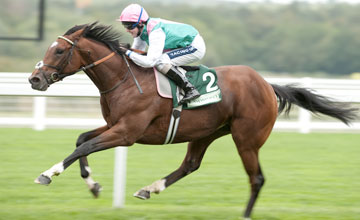
Amazingly well-developed, even as a two-year-old. Photograph by Edward Whitaker:

 
Frankel wins The Juddmonte Royal Lodge Stakes at Ascot 25.09.2010

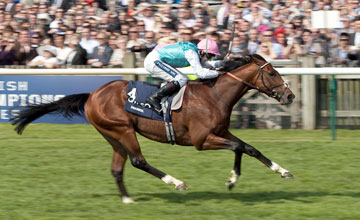
At three, in his pomp. Photograph by Edward Whitaker:

Frankel - - Newmarket Guineas Meeting 30.4.11

The first time we’ve seen him at four, doing a racecourse gallop two weeks ago, photograph by the Press Association:

Frankel with jockey Tom Queally.

His lovely face, by Alan Crowhurst:

Frankel by Alan Crowhurst

 
No pictures from me just now; I might do a later blog with pictures this evening, if I have any strength left in me. Win or lose, I shall be wiped out after this, there is so much hope and emotion invested.

There’s a lovely little BBC film about him here, if you would like to see the beauty in action:
http://www.bbc.co.uk/sport/0/horse-racing/13769548

LinkWithin

Blog Widget by LinkWithin